
WAR BEGINS – 1st September 1939
Alone and unaided, Poland was the first of the allies to stand up and fight against Germany on 1 September 1939.
On August 25, 1939, the German pre-dreadnought battleship Schleswig-Holstein , commissioned in 1908, arrived in the port of Danzig under the pretense of a courtesy visit. At 4.43 am on the 1st September 1939 it dropped anchor and positioned itself on the bend of the Vistula River and opened fire on the Polish military depot on the Westerplatte peninsula, marking the beginning of World War II.
Germany, employing 85% of her forces (1.5 million) attacked Poland from three sides. During the 36-day campaign, the Poles, inflicted heavy losses on the Germans [i] who suffered a total of 16,000 [ii] officers and men killed; 27,278 wounded; and 5,029 missing. German tanks amounting to 217 (25%) [iii] and 400 (almost 20%) of German aircraft of all types were destroyed during the period 1-3 September. Significantly, in an operation that lasted six weeks, the Germans used eight months of fuel, ammunition and repairs [iv].
The Opening shots of the Second World War , happened on the 1st September at 4.45 am , when when the Kriegsmarine’s battleship Schleswig-Holstein opens fire on the Polish military fort at Westerplatte which lies on the approach into Danzig (Gdansk) harbour on the Baltic Sea. The remainder of the German forces crossed the Polish border at various locations , en- masse, at 6am .
Invasion tracks from Germany , Prussia , Czechoslovakia
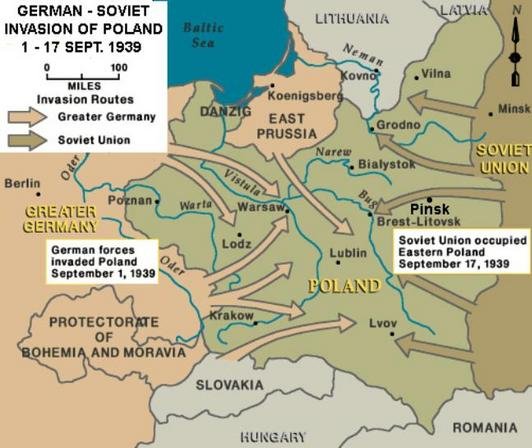
On 17 September 1939, the Soviets in alliance [vii] with Germany invaded from the east. They employed [viii] 24 infantry divisions, 15 cavalry divisions, and nine tank brigades, an estimate of 600,000 troops in all. Germany and Russia supported each other with an exchange of resources, materials, intelligence information and even prisoners. The Poles were now defending their country against two of the greatest military powers in Europe, if not the world. No other country could have withstood such an onslaught.
On 1 October 1939, Germany and the Soviet Russia divided Poland between them, agreeing new demarcation lines along the River Bug.
At Kock on 5 October 1939 the Poles had to abandon the battle because they had fired their very last bullet.
The opportunity for a successful Allied attack against Germany had passed by the time the Polish Campaign ended. General Alfred Jodl remarked at the 1946 Nuremberg Trial “… the expenditure in ammunition, gasolne, and materiel (equipment) was such as to preclude concurrent German operations on a similar scale in the west or elsewhere” [v], and thus highlighted how British and French inactivity amazed the Germans. The German Field Marshal Gerd von Rundstedt commented on the same inactivity of Poland’s allies “we were never, either in 1938 or 1939, actually in a position to withstand a concentrated attack by these States together. And, if we did not collapse in the year 1939, that was due only to the fact that during the Polish campaign, roughly 110 French and British divisions in the West were completely inactive as against the 23 German divisions” [vi]. He further remarked that the Polish Army merited great respect.
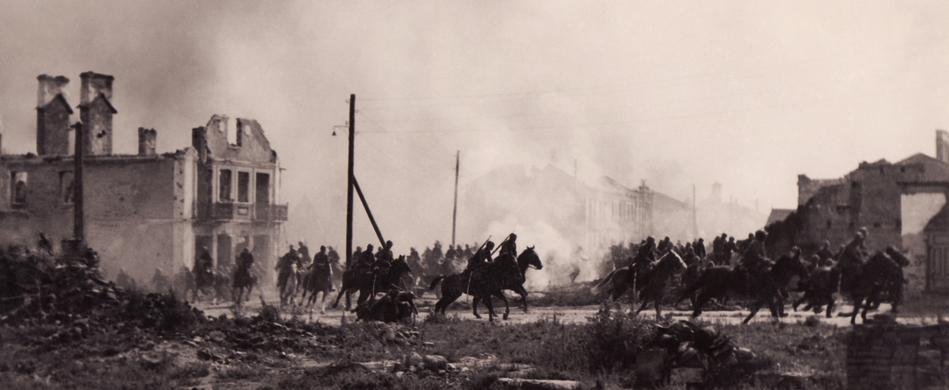
Up to the end of October 1939, Polish losses in the east amounted to nearly 200,000 dead and wounded and 200,000 prisoners of war were taken by the Soviets. Polish losses in the west amounted to 66,300 killed; 133,700 wounded; and 587,000 taken prisoner by the Germans. Polish civilian deaths reached nearly 100,000 [ix]. Approximately six million Polish citizens died in WW II; almost three million were ethnic Poles and over three million were Jews.
Although the Allies had nine months to prepare for the French Campaign from 10 May 1940 to 22 June 1940, the struggle against the Germans at a ratio of 3:2 lasted barely a week longer than that of the Polish Campaign where the ratio was 3:1. The Allies had superiority at sea and almost parity in ground and air forces [x]. The 141 German Divisions defeated the 114 French and British Divisions and took 1,900,000 French prisoners amounting to what was almost twice the size of the entire Polish Army.
Key Timestamps for the Kresy Deportees
| Year | Date | Event |
| 1939 | 01 September | World War II breaks out. Germany attacks Western Poland. |
| 1939 | 17 September | The Red Army invades Kresy (Eastern Borderlands of Poland). |
| 1940 | 09-10 February | First deportation of Poles from their homes in Kresy takes place. |
| 1940 | 12-13 April | Second deportation |
| 1940 | 28-29 June | Third deportation |
| 1941 | 13-22 June | Fourth deportation |
| 1941 | 30 July | The Polish-Soviet Agreement [Sikorski-Maisky pact] is signed. |
| 1941 | 12 August | Amnesty is granted for all Poles in the Soviet Union; the formation of Polish units in the USSR begins. |
| 1942 | March | A total of 45,000 Polish soldiers and 25,500 civilians are taken by train and by ship from Central Asia to Iran. |
| 1942 | 24 March | The first ship leaves Krasnovodsk in Turkistan. |
| 1942 | 08-30 August | The second evacuation begins and continues for a couple of months: a total of 33,000 military but only 11,000 civilians leave. |
| 1943 – 1944 | December 1943 – mid-April 1944 | The Polish 2nd Corps, under the command of General W Anders, lands in Italy. |
| 1944 | 26 April | The Polish Heavy Artillery Corps is moved into position on Monte Cassino. |
| 1944 | 04 May | The Polish 2nd Corps reaches Monte Cassino in Italy. |
| 1944 | 11-18 May | The offensive starts with an artillery barrage at 23.00; the Polish 2nd Corps engages in the 4th Battle of Monte Cassino which ends in the capture of the Monastery Hill, thus securing the opening of the road to Rome for the Allied forces. |
| 1944 | 18 May | At 09.50 a banner of the 12th Podolski Cavalry Regiment is placed on the highest point of the ruins of the Monastery at Monte Cassino. |
| 1944 | 18 May | Emil Czech of the 12th Podolski Cavalry Regiment plays the ‘Mary Bugle’ (Hejnal Mariacki) in front of the Monastery at Monte Cassino. |
| 1944 | 16 June-18 July | The Battle of Ancona leads to the capture of this port by the Polish 2nd Corps. |
| 1944 | November- December | Tehran Conference takes place. |
| 1945 | January | The Polish 2nd Corps reaches the River Senio, initiating three months of static warfare in preparation for the assault on Bologna. |
| 1945 | 04-11 February | Yalta Conference takes place. |
| 1945 | 09-21 April | Bologna is taken by the Polish 2nd Corps. |
| 1945 | 08 May | World War II ends! V-E Day. |
Footnotes
[i] The German Campaign in Poland (1939), Robert M. Kennedy [Page 120].
[ii] The German death rate here is much contested ranging from 18,000 to 8,000. Historian P.P. Wieczorkiewicz gives German losses as 16,000 killed and 30,000 wounded. SPK also gives 16,000 Germans killed.
[iii] Altogether 993 tanks and armoured cars were taken out of action, including the 217 tanks that were totally destroyed and 457 rendered inoperable. The German Campaign in Poland (1939), Robert M. Kennedy [Page 120].
[iv] Germany at War: 400 Years of Military History. Edited by David T. Zabecki PhD [Page 1011].
[v] Nuremberg Tribunal, Crimes Against Humanity, War Crimes: 3-6 June 1946: Sessions 145-148. (Nizkor Project).
[vi] The German Campaign in Poland (1939), Robert M. Kennedy [Page 130].
[vii] Stalin and Hitler signed a non-aggression pact, known as the Molotov-Ribbentrop Treaty. Secret protocols of the treaty divided Poland between Germany and Russia after a successful invasion of Poland.
[viii] The Eagle Unbowed, Halik Kochanski [Page 78].
[ix] Germany at War: 400 Years of Military History. Edited by David T. Zabecki PhD [Page 1011].
[x] Ibid [Page 1011].